Everyday Living
A sketching kit for a room with no spare room
Keep one drawing project ready to pick up, then clear the dining table without losing your place.
A hobby does not need its own room, but it helps to have somewhere for the unfinished part to go. If your sketchbook stays on the dining table because putting it away feels like abandoning the drawing, build a kit around that one project. The aim is to return to the same page with the tools and next move ready, while leaving the table available for dinner.
Choose the next session first
Put out what you used for one ordinary pencil-sketching session: the sketchbook, a few pencils, an eraser and a sharpener with a shavings container. Add the reference you actually need. A whole box of unused pencils does not have to travel with this project.
Keep spare paper, duplicate tools and finished sketchbooks in their existing storage. If you work on two drawings, choose which one this kit is for. A second unfinished project needs its own identifiable place, rather than becoming a hidden layer under the first.
Keep the tools beside the work
Use a pencil case for loose tools rather than leaving them rolling across the sketchbook. Canson advises putting drawing materials in cases for transport and protecting pencils from shocks, since their leads can break inside the wood. That supports careful handling; it does not prove that any particular storage box will protect your supplies.
Try your existing case beside the closed sketchbook in a shallow tray or box. Keep the case off the drawing surface and do not force the book shut around bulky objects. Use the paper and medium maker’s care guidance for the artwork itself. An everyday carry kit is not an archival-storage system, and this arrangement is not intended for wet paint or loose charcoal.
Source: Canson: Cleaning, maintaining and preserving your drawing material ↗
Give the kit a real destination
Choose its storage place before looking for a container: perhaps a reachable cupboard shelf near the table. Place the actual book and case there. Check that you can take them out without unloading the shelf, and that the door closes without pressing on them.
If a tray makes the group awkward to carry, use two manageable pieces instead: the sketchbook and its tool case. They can live next to each other without sharing one large box. If the only available shelf requires the sketchbook to bend or the kit to overhang, choose a different destination rather than squeezing it in.
Leave a note that gets you drawing again
Before packing away, write one concrete next move on a separate card: “Return to the mug drawing on page 12; compare the handle with the reference.” Put the card where you will see it when opening the kit. Keep it loose rather than sticking adhesive onto the drawing.
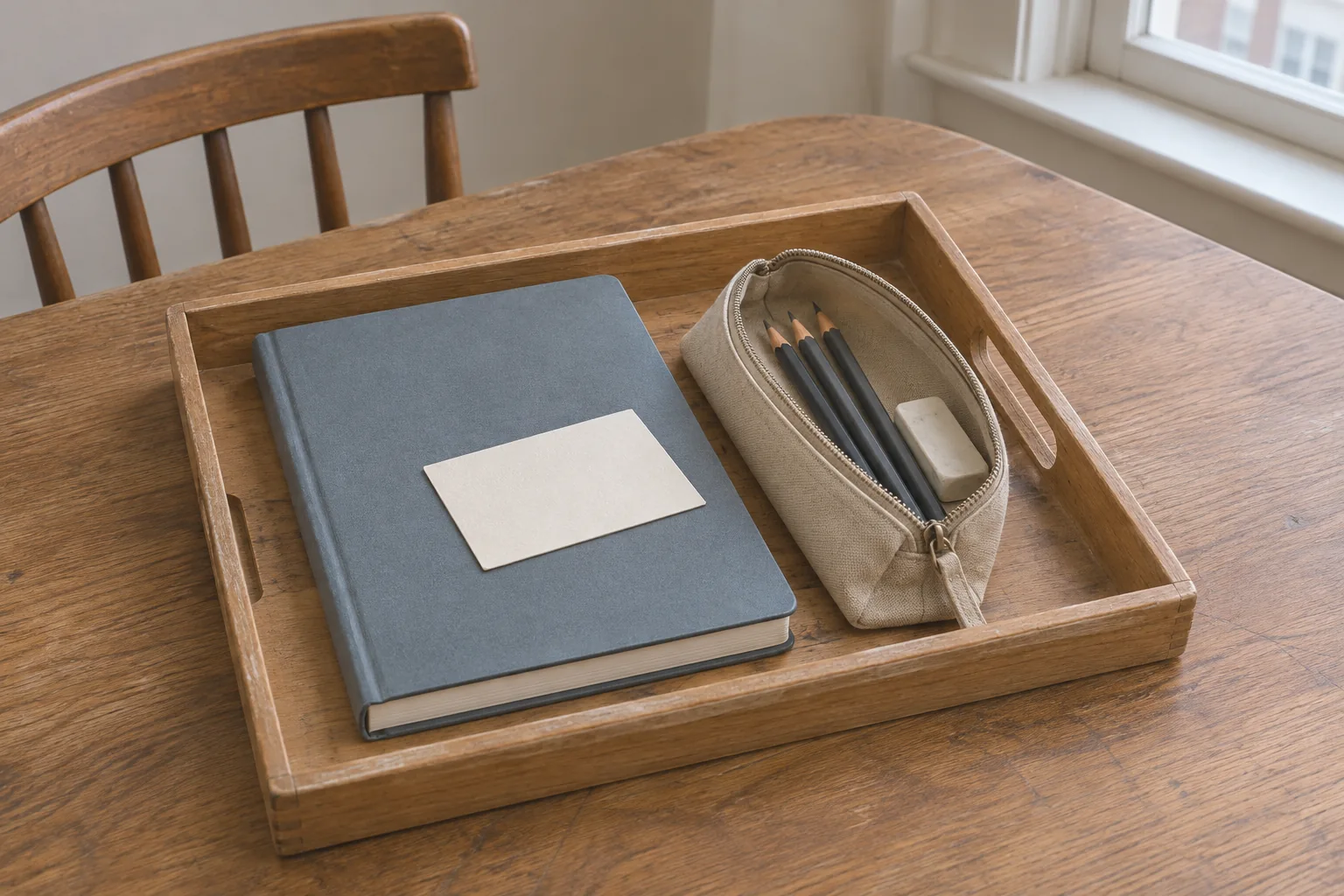
Here is a hypothetical setup: one closed sketchbook and one zipped pencil case sit side by side in a tray, with the return card on top. Before dinner, close the case, gather the reference and carry the kit to its shelf. Clear away eraser crumbs and any shavings before setting the table. Next time, bring back the same group, open to the named page and follow the note. If your reference is on a phone, record where to find it rather than leaving the phone in storage.
Reopen it before deciding what to buy
Rehearse putting the kit away and bringing it back to the table. Notice the first interruption: a pencil missing its case, a reference buried elsewhere, or a lid that will not close. Fix that specific problem before adding more compartments.
When a drawing is finished, remove its return card and decide which project is next. Keep completed work in a suitable separate home using the medium’s care guidance. The kit stays useful when it holds what you are making now, rather than gradually becoming the archive of everything you have made.
This is an editorial routine and hypothetical setup, not a firsthand product test or artwork-preservation guarantee. Choose storage and handling suited to your actual paper and medium. The generated image is a design concept showing separate places for tools and a book; it does not establish dimensions or prove that a product fits.
Sources & details
- Cleaning, maintaining and preserving your drawing material ↗ · Canson, checked 2026-11-16
Design concepts use generated imagery. How we make Apartmentwise · Suggest a correction